British post boxes are one of those everyday features you can easily overlook when travelling around the UK. They’re familiar, practical, and so woven into British life that most people probably walk straight past them without giving them a second thought.
That changed for me once I started noticing that not all post boxes are the same. I’ve photographed a few across Britain, including a King George post box at Land’s End in Cornwall and, even more surprisingly, a Queen Victoria post box just a couple of blocks from where I live in Harborne, Birmingham.
Once you start paying attention, these red boxes stop being just bits of street furniture. They become small pieces of history hiding in plain sight, each one carrying clues about the time it was made, the monarch on the throne, and the evolution of Britain’s postal system.
In this guide, I’ll break down the history of British post boxes, explain what the royal cyphers mean, and share what to look for if you start spotting them on your own travels around the UK.
Why British post boxes are more interesting than they look
British post boxes are easy to take for granted. You see them on residential streets, outside shops, in villages, city centres and even at places like Land’s End.
But once you start looking closely, they’re not all the same.
The shape, design and royal cypher can reveal when a post box was installed and which monarch was on the throne at the time. That means an ordinary red box you pass on the pavement could date back to the Victorian era or the reign of one of the King Georges.
That’s what made me start paying more attention to them.
I’ve photographed a King George post box at Land’s End in Cornwall, and closer to home in Harborne, Birmingham, there’s a Queen Victoria post box just a couple of blocks away from where I live. I find it quite fascinating that something still used as part of everyday life can also be a small surviving piece of British history.
For travellers, they’re also an easy detail to notice without having to visit a museum or historic attraction. Once you know what to look for, spotting the different cyphers and designs adds another layer of context when exploring towns and cities around Britain.
The history of British post boxes
The British post box dates back to the 1850s, but the idea didn’t begin with the familiar red pillar box we know today.
Anthony Trollope, better known as a Victorian novelist, worked for the Post Office as a Surveyor’s Clerk. His job involved travelling extensively, including visits to France and Belgium, where roadside letter boxes were already in use.
Trollope proposed introducing a similar system in Britain. The Post Office approved a trial in the Channel Islands, and 4 cast iron pillar boxes came into use in Jersey on 23 November 1852. The trial was extended to Guernsey the following year.
After proving useful in the Channel Islands, post boxes began appearing on the British mainland in 1853.
Early post boxes were far from standard
If you could walk around Britain in the 1850s looking for post boxes, you wouldn’t necessarily know what shape to look for.
Local Post Office surveyors were initially responsible for arranging their design, manufacture and installation. As a result, early boxes varied considerably from place to place.
Some had vertical posting slots, while others had horizontal ones. Different shapes and decorative styles appeared as the Post Office worked out which designs were actually practical.
By 1859, the Post Office introduced its first national standard pillar box. It had a cylindrical body, making it an important step towards the shape we now associate with British post boxes.
The Penfold post box arrived in 1866
Another distinctive design appeared in 1866, created by architect John Wornham Penfold.
The Penfold was hexagonal rather than cylindrical and came in 3 sizes. Its decorative appearance made it popular, but it was comparatively expensive to manufacture and the design was eventually discontinued.
You can still come across Penfold style boxes today, although some are later replicas placed in locations of historic or scenic interest.
The familiar pillar box takes shape
A new standard design appeared in 1879, and this is where the family resemblance to today’s British post boxes becomes much easier to spot.
The new Type A and smaller Type B pillar boxes had cylindrical bodies, rounded tops, horizontal posting slots and front opening doors. Their basic form proved remarkably successful.
The design has changed and adapted since then, but that late Victorian pillar box helped establish one of the most recognisable pieces of British street furniture.
When you see an old post box today, you’re not necessarily looking at a reproduction of the past. Many historic boxes remain part of the working postal network, which is one reason I find them worth paying attention to when travelling around Britain.
Why are British post boxes red?
The bright red colour is probably the first thing most people associate with a British post box, but they haven’t always been red.
The earliest post boxes installed in Jersey in 1852 were red, but when the Post Office began standardising letter boxes across Britain in 1859, green became the official colour. The idea was for them to blend more naturally into their surroundings.
That turned out to be slightly too successful.
People complained that the green boxes could be difficult to find, particularly when they blended into the surrounding landscape. In 1874, the Post Office decided to return to red so the boxes would be easier to spot.
The change didn’t happen overnight. Repainting post boxes across Britain took around 10 years, after which red became the standard colour for most British post boxes.
There have been a few exceptions over the years. Blue boxes were introduced for airmail during the 1930s, while some post boxes were famously painted gold to celebrate British gold medal winners during the London 2012 Olympic Games.
Today, that familiar red has become so closely associated with Britain that it’s easy to forget it began as a practical decision. The colour wasn’t chosen simply to look distinctive. It helped people find somewhere to post their letters more easily.
What do the royal cyphers on British post boxes mean?
One of the easiest ways to work out the age of a British post box is to look at its royal cypher.
A royal cypher combines the monarch’s name or initials with their title. The letter R usually stands for Rex for a king or Regina for a queen, both from Latin.
When a new monarch comes to the throne, Britain’s older post boxes aren’t replaced. They generally keep the cypher they were originally given, while newly produced boxes carry the cypher of the new monarch. That is why you can still find Victorian post boxes working alongside much newer ones today.
Once you know the basic designs, spotting them becomes surprisingly addictive.
Queen Victoria and the VR cypher
Queen Victoria’s cypher is VR, meaning Victoria Regina.
Victorian post boxes are particularly interesting because there wasn’t one standard Post Office cypher throughout her reign. By the 1880s, however, an ornate version with the letters V and R intertwined had become more consistent. Unlike many later royal cyphers, the Victorian version usually didn’t have a crown above it.

I have one of these practically on my doorstep.
Just a couple of blocks from where I live in Harborne, Birmingham, there’s a working pillar box carrying the intertwined VR cypher. I’d passed post boxes countless times before, but seeing a Victorian one still being used in an ordinary residential street made me appreciate how much history is sitting quietly around us.

King Edward VII and EVII R
When Edward VII became king in 1901, his Post Office cypher incorporated E and R, meaning Edward Rex, alongside the Roman numeral VII.
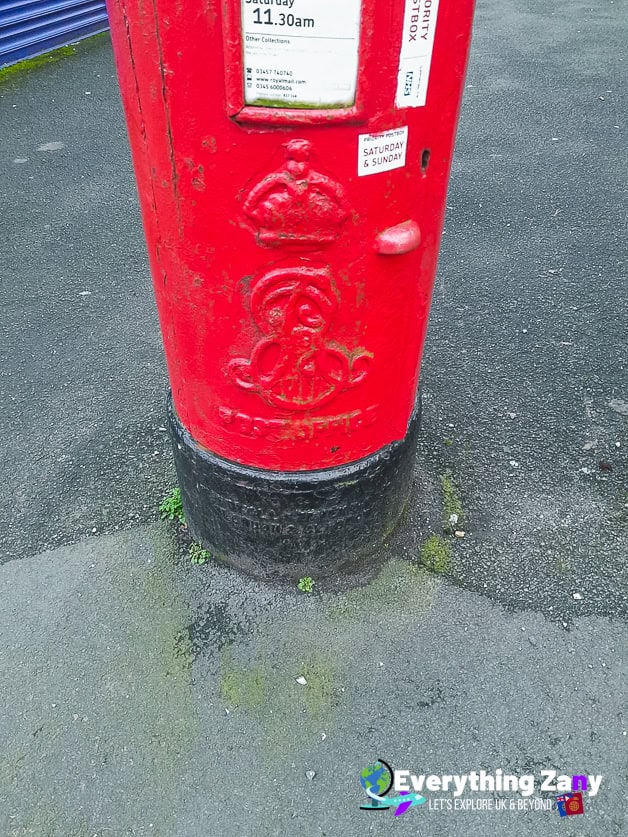
Unlike Victoria’s later cypher, Edward VII’s design was normally topped with a crown.
King George V and the simple GR
George V’s post box cypher is one of the easiest to recognise.
Rather than using GVR, the Post Office adopted the much simpler GR. The letters aren’t intertwined, and the Roman numeral V was left out altogether.

carrying the simple GR cypher.
King Edward VIII and the rare EVIIIR boxes
King Edward VIII was on the throne for only 326 days in 1936, but post boxes carrying his cypher were still produced.
His Post Office cypher incorporated E, VIII and R. Fewer than 200 post boxes were produced during his short reign, making them much harder to find than boxes from most other monarchs.
So if you ever find one while wandering around Britain, that genuinely is one worth photographing.
King George VI and G VI R
George VI’s cypher looks quite different from his father’s.

Instead of George V’s simple GR, the Roman numerals VI sit between the larger G and R. The letters are also more decorative and intertwined.
Queen Elizabeth II and EIIR
Queen Elizabeth II’s familiar cypher is EIIR, meaning Elizabeth II Regina.
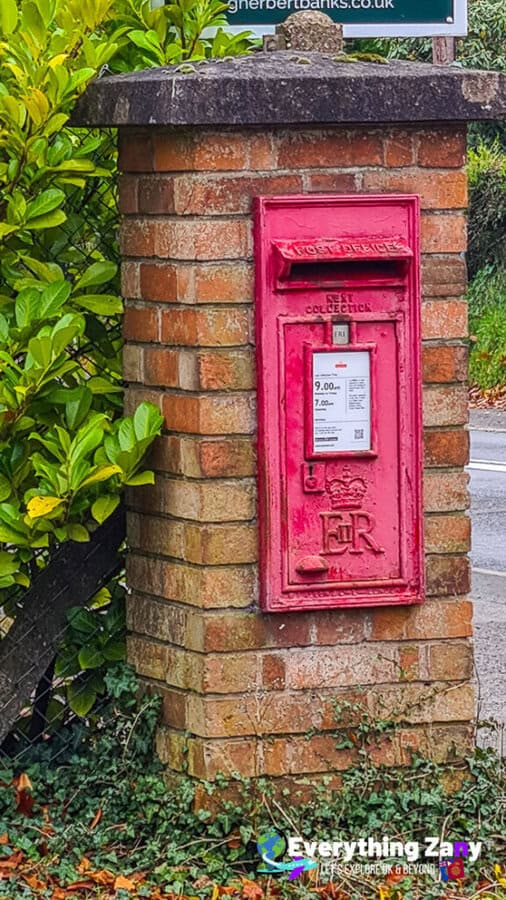
The Roman numeral II sits between the E and R. Because her reign lasted for 70 years, EIIR is one of the easiest royal cyphers to find on post boxes around Britain.
King Charles III and the new CIIIR cypher
King Charles III’s cypher combines C, III and R, with R standing for Rex.
The first post box carrying the new cypher was unveiled in Great Cambourne, Cambridgeshire, on 12 July 2024. Its cypher was painted gold to mark its significance, while later Charles III post boxes use the cypher in red.
Older post boxes haven’t been converted to CIIIR. A Victorian VR box remains Victorian, just as an EIIR box continues to carry Queen Elizabeth II’s cypher.
I haven’t photographed a Charles III post box yet, so that’s one I’ll have to keep an eye out for.
And I think that final sentence is worth keeping. It turns the article into an ongoing personal observation rather than pretending your collection is complete.
A quick royal cypher spotting guide
| Monarch | Post box cypher | What to look for |
| Queen Victoria | VR | Often ornate and intertwined |
| Edward VII | EVII R | Edward’s initials with VII and a crown |
| George V | GR | Simple G and R without the V |
| Edward VIII | EVIIIR | Rare due to his short reign |
| George VI | G VI R | VI positioned between G and R |
| Elizabeth II | EIIR | II positioned between E and R |
| Charles III | CIIIR | Charles III Rex with the Tudor Crown |
One small warning though. The cypher helps you identify which monarch’s reign a post box belongs to, rather than giving you its exact year. For that, you’d normally need to look more closely at its design, manufacturer and surviving records.
Why Scottish post boxes have a different royal symbol
If you look closely at post boxes in Scotland, you may notice something missing. Many of them don’t carry the familiar EIIR cypher used during Queen Elizabeth II’s reign.
The reason goes back to the early 1950s.
When Elizabeth II came to the throne in 1952, some people in Scotland objected to the use of the numeral II. Queen Elizabeth I had ruled England and Wales, but she had never been Queen of Scotland. From that perspective, Elizabeth II was not the second Scottish monarch named Elizabeth.
The first Scottish post boxes carrying EIIR became the focus of protests. Some were vandalised, and the dispute escalated to attacks and threats against Post Office property.
In 1954, a different approach was adopted for Scotland. Instead of using the monarch’s letters and regnal number, new Scottish post boxes used the Crown of St Andrew, part of the Honours of Scotland, on its own.
That tradition continued throughout Queen Elizabeth II’s reign and remains relevant today. The Postal Museum notes that King Charles III’s CIIIR cypher is not being applied to new post boxes in Scotland, where the Crown of St Andrew continues to be used instead.
So, if you’re travelling around Scotland and see a post box with a crown but no familiar EIIR or CIIIR lettering, it isn’t missing its cypher. You’re looking at a distinct part of Scotland’s postal history.
Different types of British post boxes
The classic red pillar box may be the most recognisable, but British post boxes come in several different forms.
Their designs developed around practical needs. Busy urban areas needed larger boxes with more capacity, while villages and quieter locations often needed something smaller and cheaper to install. Over time, that gave Britain a surprisingly varied collection of post boxes.
Pillar boxes
Pillar boxes are the free-standing post boxes most people probably picture when they think of the British postal system.

The familiar cylindrical design began taking shape during the Victorian period. By 1879, the Post Office had introduced the Type A and smaller Type B pillar boxes, with rounded tops, horizontal posting slots and black bases. That basic design became one of the most recognisable forms of British street furniture.
Wall boxes
Wall boxes were introduced in 1857 as a smaller and less expensive alternative to pillar boxes. Instead of standing independently, they were built directly into walls or purpose-built brick pillars.
They were particularly useful in smaller towns and rural areas, where the volume of mail didn’t justify installing a large pillar box. Larger versions were eventually produced as the design proved successful.
Lamp boxes
Lamp boxes are smaller again.
They were introduced in 1896, originally so they could be attached to lamp posts in London. Their compact size made them useful in places where relatively little mail was posted.
They later became common in villages and rural areas, where you may still see them fixed to lamp posts, telegraph poles or their own small pedestals.
Double-aperture and higher-capacity boxes
Busier locations sometimes needed larger boxes with more capacity.
Over the years, the Post Office experimented with larger designs and boxes with multiple posting apertures to cope with heavier volumes of mail. The familiar cylindrical design remained popular, but various square and higher-capacity models were also introduced during the 20th century.
Modern post boxes
The design continues to evolve.
Royal Mail currently operates more than 110,000 post boxes across the UK, and modern boxes are still used for everyday letters and some prepaid parcels.
That is part of what makes the older examples so interesting to me. Victorian, Edwardian and 20th-century boxes aren’t always museum pieces. Many are still standing on ordinary streets doing essentially the same job they were installed to do.
Post boxes as part of everyday British culture
British post boxes haven’t just survived as pieces of postal infrastructure. They have also become part of the visual character of towns and cities.
One of the more playful examples I’ve photographed was a London post box covered with a knitted topper featuring Danger Mouse, Big Ben and little knitted details around the edge. The box itself was also displaying a plaque celebrating 50 years of Royal Mail Special Stamps.

It has absolutely nothing to do with identifying the age of the box, but I rather like it because it shows how something so ordinary can become part of the personality of a street.
A George V post box at Land’s End
A few years ago, I visited Land’s End in Cornwall with my husband and mother-in-law as part of my birthday celebration. We spent some time travelling around Cornwall, and this old post box was one of those little details I happened to notice along the way.
Built into the wall is a red post box carrying the simple GR cypher of King George V. Above it, a plaque describes it as the “first and last post box in England”, a fitting little detail considering its location at the western end of the country.
The box is no longer in use, and the notice directs visitors to another Royal Mail post box near the visitor centre. But I think the older box is far more interesting from a historical point of view.
It is also a good example of a wall box, rather than the free-standing pillar boxes most people associate with British post boxes.
What I like about finding details like this when travelling is that they add another layer to a place. Land’s End is naturally known for its coastal scenery and geographical location, but tucked into the stonework is this small reminder of Britain’s postal history.
Once you start looking at the royal cyphers, these things become much easier to notice.
Are British post boxes still used today?
Yes. Historic post boxes may look like relics from another era, but many are still part of the working postal network.
Royal Mail currently has more than 110,000 post boxes across the UK, including traditional post boxes and newer parcel post boxes. Regular boxes can still be used for letters and smaller prepaid parcels that fit through the opening.
That is part of what makes spotting an older box so interesting. A Victorian or George V post box isn’t necessarily preserved purely for appearance. In many cases, it is still being used for essentially the same purpose it was installed for decades, or even more than a century, ago.

When I photographed the Victorian VR pillar box near my home, it was still in everyday use and even carried a Priority Postbox notice during the COVID-19 period.
How to check collection times
If you’re actually using a post box rather than simply admiring the cypher, check the collection information displayed on it.
Collection times vary by location, and Royal Mail’s online location finder can also show individual post boxes and their latest collection times.
It is worth checking rather than assuming that every box is collected at the same time, particularly at weekends.
Post boxes have adapted to parcels too
The postal network hasn’t stayed completely Victorian either.
Royal Mail now also operates parcel post boxes, which have larger openings designed for prepaid parcels that won’t fit through a standard letter box. They sit alongside traditional post boxes rather than replacing them.
Where to learn more about British postal history
If spotting old post boxes has made you curious about the wider story of Britain’s postal system, The Postal Museum in London is probably the most obvious place to continue.
The museum covers around 500 years of postal history, from the development of the postal service to the people, technology and infrastructure behind it. One of its better-known attractions is Mail Rail, the underground railway once used to move post beneath London.
I still haven’t managed to visit it myself, even though it has been on my London list for quite a while. Every time I plan to go, I somehow end up squeezing in errands, meeting friends or doing something else while I’m in the city.
So this is one of those places I’m recommending as a research resource rather than from personal experience.
If you’re particularly interested in post boxes rather than postal history more generally, the Letter Box Study Group is another useful resource. The group was founded in 1976 and specialises in documenting the history, design and surviving examples of British roadside post boxes. It has identified hundreds of different post box types and maintains detailed records of boxes around the country.
For anyone who starts noticing royal cyphers and old designs on their travels, it is surprisingly easy to fall down that particular rabbit hole.
Planning a visit to The Postal Museum
The Postal Museum is on Phoenix Place in London, close to Clerkenwell and King’s Cross. It is currently open Tuesday to Sunday from 10:00 to 17:00, although opening arrangements can change, so I’d check the official website before travelling.
General admission includes access to the museum and a Mail Rail ride on the first visit, while some additional experiences require separate booking.
I’ll update this section properly once I finally manage to visit.
Frequently asked questions about British post boxes
Who introduced post boxes to Britain?
The introduction of roadside post boxes in Britain is closely associated with Anthony Trollope, the Victorian novelist who also worked for the Post Office.
He suggested using roadside letter boxes after seeing similar systems during his work in Europe. A trial began in Jersey in 1852, followed by Guernsey in 1853, before post boxes started appearing on the British mainland.
Why are British post boxes red?
Post boxes were standardised in green in 1859, but people complained that they were difficult to spot.
In 1874, the Post Office began changing them to red so they would stand out more clearly from their surroundings.
What do the letters on British post boxes mean?

The letters form the royal cypher and usually indicate which monarch was reigning when the post box was produced.
For example, VR refers to Queen Victoria, GR can indicate George V, G VI R refers to George VI and EIIR belongs to Queen Elizabeth II.
Does the royal cypher tell you exactly how old a post box is?
Not exactly.
The cypher tells you the monarch’s reign, which helps narrow down the period when the box was made. To date a post box more precisely, you may also need to look at its design, manufacturer and historical records.
What is the oldest post box still in public service?
A pillar box at Barnes Cross in Holwell, Dorset, dates from 1853 and is believed by Historic England to be the oldest post box still in public service.
It carries Queen Victoria’s VR initials and has an unusual polygonal design quite different from the cylindrical pillar boxes that later became standard.
Why are post boxes in Scotland different?
During Queen Elizabeth II’s reign, there was opposition in Scotland to the use of EIIR because Elizabeth I had not been Queen of Scotland.
From the 1950s, Scottish post boxes instead used the Crown of St Andrew without the monarch’s initials. That distinctive Scottish approach has continued with new post boxes during the reign of King Charles III.
Are old British post boxes still used?
Many are.
Royal Mail does not replace a post box simply because the monarch changes. Existing boxes retain their original royal cypher, which is why Victorian and 20th-century boxes can still be found in everyday use alongside newer examples.
Are all British post boxes pillar boxes?
No. The free-standing cylindrical pillar box is the most recognisable type, but Britain also has wall boxes, lamp boxes and larger capacity designs.
Wall boxes were introduced in 1857, while smaller lamp boxes first appeared in 1896.
Can you still find Victorian post boxes today?

Yes, and this is one of the reasons I started paying more attention to them.
There is a working Victorian VR pillar box only a couple of blocks from where I live in Harborne, Birmingham. Once you know what the different cyphers mean, spotting older boxes becomes another little way of reading Britain’s history while you’re travelling.
Start looking a little closer
British post boxes are easy to overlook because they are such a familiar part of everyday life. But once you start noticing the cyphers, shapes and small design differences, they become much more interesting.
That is what happened to me.
A Queen Victoria post box a couple of blocks from home in Harborne, a George V wall box at Land’s End, and a few others I’ve photographed along the way have made me look at these red boxes differently.
They are practical objects, but they are also small pieces of British history still sitting in ordinary streets, villages and town centres.
So next time you pass one, have a quick look at the royal cypher. You might be standing beside something that has been there for far longer than you realised.
